Vitamins for Perimenopause: What Actually Helps (& Why)
Looking for vitamins that actually support perimenopause symptoms? This evidence-based guide covers what works, what doesn't, and how to choose supplements wisely.
NUTRITION
4/14/202613 min read
You've probably seen the ads. The influencers. The wellness brands promising that their proprietary blend of 47 ingredients will "balance your hormones naturally" and make perimenopause a breeze.
Meanwhile, you're standing in the supplement aisle — or scrolling through an endless sea of Amazon reviews — wondering which of the 200+ options might actually help you sleep through the night, think clearly, or stop sweating through your sheets at 3 AM.
Here's the truth: some vitamins and minerals genuinely support perimenopausal health, and the research backs them up. Others are overhyped, understudied, or simply not what your body needs right now.
This guide cuts through the noise. We'll cover what the science actually says, what women in the real world report, and how to build a supplement strategy that makes sense for your body, your symptoms, and your budget.
No magic pills. No wellness theater. Just evidence-based information you can actually use.
This article is based on current medical knowledge and real-life experiences, but does not replace medical advice. Before starting any new supplement regimen, especially if you have underlying health conditions or take medications, consult a healthcare provider.
Why Your Nutrient Needs Change During Perimenopause
You're not imagining that your body feels different. It is different — and not just hormonally.
Hormonal Shifts and Nutrient Depletion
During perimenopause, fluctuating estrogen and progesterone don't just cause symptoms — they also alter how your body absorbs, uses, and stores nutrients.
Estrogen decline affects:
Calcium absorption and bone density — estrogen helps bones retain calcium; when it drops, bone loss accelerates
Vitamin D activation — estrogen enhances the conversion of vitamin D to its active form
Magnesium retention — lower estrogen is associated with increased urinary magnesium loss
Collagen synthesis — vitamin C-dependent collagen production decreases
Other hormonal factors:
Progesterone fluctuations affect mood, sleep, and GABA function — all of which are influenced by B vitamins and magnesium
Cortisol elevation (common during perimenopausal stress) depletes B vitamins, vitamin C, and magnesium
Thyroid function shifts can alter iron and iodine needs
Absorption, Stress, and the Midlife Body
Beyond hormones, several midlife factors compound nutrient challenges:
Gut changes — digestive efficiency often decreases with age, reducing absorption of B12, iron, and fat-soluble vitamins
Chronic stress — depletes magnesium, B vitamins, and vitamin C faster than they can be replenished through food alone
Medications — common midlife prescriptions (PPIs, metformin, statins, certain antidepressants) can interfere with nutrient absorption
Dietary changes — many women eat less overall in midlife, which can create subtle deficiencies even in those with "healthy" diets
The result: your body may need more of certain nutrients at exactly the time it's becoming harder to get them from food alone.
What Women Actually Experience
The Supplement Overwhelm
Walk into any conversation about perimenopause supplements, and you'll hear a dizzying range of opinions:
"Maca changed my life."
"I tried maca and it did nothing."
"You HAVE to take magnesium."
"My doctor said supplements are useless."
"I'm taking 15 different things and I still feel terrible."
The contradiction is exhausting. And it leads many women to one of two extremes:
Supplement overload — taking handfuls of pills based on wellness trends, without knowing if any of them are actually helping
Supplement avoidance — dismissing all supplements as snake oil because the claims seem too good to be true
Neither extreme serves you well.
"I Tried Everything — Here's What Made a Difference"
In our reader surveys and perimenopause communities, certain patterns emerge:
Magnesium is the most consistently praised supplement. Women describe improvements in sleep, muscle tension, anxiety, and headaches — often within days to weeks.
B vitamins — particularly B12 and B6 — are frequently mentioned for energy, mood, and cognitive clarity.
Vitamin D improvements often come with blood testing that reveals profound deficiency. Women who correct their vitamin D levels report better mood, energy, and immune function.
Omega-3s are described as helping with brain fog, joint pain, and mood — though effects are typically subtle and cumulative.
Herbal supplements get mixed reviews. Some women swear by black cohosh or maca; others notice nothing. Individual response varies dramatically.
The takeaway: targeted, evidence-based supplementation tends to work better than scattershot approaches. And what works for your friend may not be what your body needs.


The 9 Most Important Vitamins and Minerals for Perimenopause
These are the nutrients with the strongest evidence for supporting perimenopausal health — and the most common deficiencies in women at this life stage.
1. Magnesium — The Perimenopause Powerhouse
What it does:
Magnesium is involved in over 300 enzymatic reactions in the body, including:
Nervous system regulation (calming, sleep support)
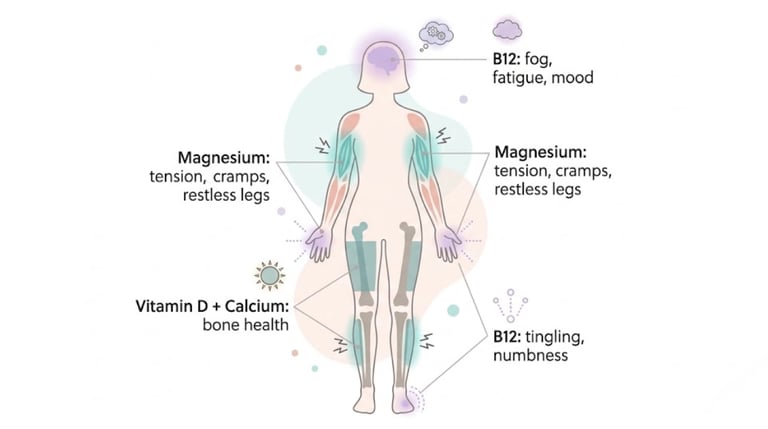
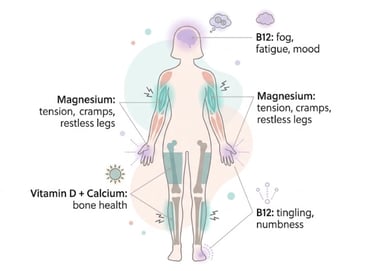
Muscle relaxation (reducing cramps, tension, restless legs)
Blood sugar balance
Mood regulation (supports GABA and serotonin function)
Hormone metabolism
Why it matters in perimenopause:
Stress depletes magnesium. Hormonal fluctuations increase magnesium needs. And most women don't get enough from food alone — modern diets and depleted soil have made magnesium deficiency widespread.
What the research shows:
Studies link magnesium supplementation to improved sleep quality, reduced anxiety, fewer migraines, and better blood sugar control — all common perimenopausal concerns.
Best forms:
Magnesium glycinate — best for sleep, anxiety, and overall absorption (gentle on digestion)
Magnesium citrate — good absorption, but can have a mild laxative effect
Magnesium threonate — crosses the blood-brain barrier; may support cognitive function
Typical dose: 200–400 mg daily (start low to assess tolerance)
Pro tip: Take magnesium in the evening. It can support sleep onset and muscle relaxation overnight.
2. Vitamin D — Beyond Bone Health
What it does:
Vitamin D functions more like a hormone than a vitamin, affecting:
Bone health and calcium absorption
Immune function
Mood regulation
Inflammation control
Muscle function
Why it matters in perimenopause:
Estrogen decline impairs vitamin D activation. Vitamin D deficiency is associated with increased risk of depression, bone loss, and immune dysfunction — all of which can intensify during perimenopause.
What the research shows:
Low vitamin D is linked to worsened menopausal symptoms in several studies. Supplementation has been associated with improved mood, reduced fracture risk, and better immune outcomes.
Important: Vitamin D deficiency is extremely common (estimates suggest 40–75% of adults are deficient). Testing is essential — both to confirm deficiency and to dose appropriately.
Best form: Vitamin D3 (cholecalciferol) — more effective at raising blood levels than D2
Typical dose:
Maintenance: 1,000–2,000 IU daily
Deficiency correction: 4,000–5,000 IU daily (under medical guidance)
Pro tip: Take vitamin D with a meal containing fat for better absorption. Consider pairing with vitamin K2 for optimal calcium routing to bones (rather than arteries).
3. Vitamin B12 — Energy, Mood, and Nerve Function
What it does:
B12 is essential for:
Red blood cell formation (prevents anemia)
Nerve health and myelin production
Energy metabolism
Mood and cognitive function
DNA synthesis
Why it matters in perimenopause:
B12 absorption declines with age due to reduced stomach acid production. Women taking metformin (for blood sugar) or PPIs (for acid reflux) are at especially high risk of deficiency.
Symptoms of deficiency:
Fatigue, brain fog, tingling/numbness, mood changes, memory issues — which overlap heavily with perimenopause symptoms, making deficiency easy to miss.
What the research shows:
B12 deficiency is common in midlife women and correcting it improves energy, mood, and neurological function. Some studies suggest B12 may also support cardiovascular health.
Best forms:
Methylcobalamin — the active form; recommended for most people
Adenosylcobalamin — another active form; good for mitochondrial support
Avoid cyanocobalamin if possible (requires conversion and contains trace cyanide)
Typical dose: 500–1,000 mcg daily (or higher for confirmed deficiency)
Pro tip: If you have digestive issues, sublingual (under-the-tongue) B12 bypasses the gut absorption pathway.
4. Vitamin B6 — Hormone Metabolism Support
What it does:
B6 plays a key role in:
Neurotransmitter synthesis (serotonin, dopamine, GABA)
Hormone metabolism and balance
Reducing PMS-type symptoms
Immune function
Why it matters in perimenopause:
B6 helps the liver process and clear excess estrogen, which can reduce symptoms related to estrogen dominance (breast tenderness, mood swings, heavy bleeding). It also supports mood by facilitating serotonin production.
What the research shows:
B6 supplementation has been shown to reduce premenstrual symptoms and may help with mood disorders. Its role in perimenopause specifically is less studied but biologically plausible.
Caution: High-dose B6 (over 100 mg daily) over long periods can cause nerve damage (peripheral neuropathy). Stick to moderate doses.
Best form: Pyridoxal-5-phosphate (P5P) — the active form, easier for the body to use
Typical dose: 25–50 mg daily (as part of a B-complex or standalone)
5. Omega-3 Fatty Acids — Inflammation and Brain Health
What they do:
Omega-3s (EPA and DHA) are anti-inflammatory fats that support:
Brain function and mood
Cardiovascular health
Joint health
Skin hydration
Hormone receptor sensitivity
Why they matter in perimenopause:
Chronic low-grade inflammation increases during the menopausal transition. Omega-3s help counteract this inflammatory shift. They also support brain health during a time when many women experience cognitive changes.
What the research shows:
Omega-3 supplementation has been linked to reduced depression symptoms, improved cardiovascular markers, and possibly reduced hot flash frequency (though results are mixed).
Best sources:
Fish oil (EPA and DHA combined) — most studied and effective
Algae oil — vegan alternative with direct DHA
Avoid relying on flaxseed oil alone (ALA converts poorly to EPA/DHA)
Typical dose: 1,000–2,000 mg combined EPA/DHA daily
Pro tip: Choose fish oil that's third-party tested for purity (heavy metals, oxidation). Store in the refrigerator to prevent rancidity.
6. Vitamin E — Hot Flash Relief and Cellular Protection
What it does:
Vitamin E is a fat-soluble antioxidant that:
Protects cell membranes from oxidative damage
Supports skin health
May modulate hormone-related symptoms
Why it matters in perimenopause:
Several studies have examined vitamin E for hot flash reduction — with modest but consistent findings suggesting benefit. It also supports skin elasticity, which often declines during hormonal transition.
What the research shows:
A 2007 study in Gynecologic and Obstetric Investigation found that vitamin E supplementation reduced hot flash severity compared to placebo. Effects are generally mild but real.
Best form: Mixed tocopherols (including alpha, beta, gamma, and delta tocopherols) rather than synthetic dl-alpha-tocopherol alone
Typical dose: 400 IU daily
Caution: High-dose vitamin E (over 400 IU) has been associated with increased bleeding risk in some studies. Don't exceed recommended doses without medical guidance.
7. Calcium — Bone Protection During Hormonal Decline
What it does:
Calcium is the primary mineral in bone tissue and is essential for:
Bone structure and strength
Muscle contraction
Nerve signaling
Heart rhythm regulation
Why it matters in perimenopause:
Bone loss accelerates rapidly during the menopausal transition due to estrogen decline. Adequate calcium intake is essential for slowing this process.
What the research shows:
Calcium supplementation, particularly when combined with vitamin D, reduces fracture risk in postmenopausal women. However, excessively high calcium intake from supplements (not food) has been associated with cardiovascular concerns in some studies.
Current guidance:
Aim for 1,000–1,200 mg daily total (food + supplements combined)
Food sources are preferred: dairy, sardines, leafy greens, fortified foods
Supplement only the gap between your dietary intake and the target
Best forms:
Calcium citrate — absorbs well without food; gentler on digestion
Calcium carbite — cheaper, but requires food for absorption
Pro tip: Don't take more than 500 mg of calcium at once (absorption maxes out). Split doses if supplementing.
8. Iron — What You Need to Know (and When to Stop)
What it does:
Iron is essential for:
Oxygen transport in the blood (hemoglobin)
Energy production
Immune function
Cognitive performance
Why it matters in perimenopause:
During perimenopause, many women experience heavy, irregular periods — leading to increased iron loss and potential anemia. Symptoms of iron deficiency (fatigue, brain fog, dizziness, hair loss) overlap with perimenopause symptoms, making it easy to miss.
Important nuance:
Once periods stop completely (postmenopause), iron needs drop significantly. Excess iron is harmful — it's a pro-oxidant that can increase cardiovascular risk and oxidative stress.
Guidance:
Test before supplementing — ferritin and complete blood count (CBC) reveal true iron status
If deficient, supplement under medical guidance
If you're no longer menstruating heavily or have stopped periods, you likely don't need iron supplements
Best form: Iron bisglycinate — well-absorbed and gentler on the stomach
9. Vitamin C — Collagen, Immunity, and Adrenal Support
What it does:
Vitamin C is a water-soluble antioxidant that supports:
Collagen synthesis (skin, joints, blood vessels)
Immune function
Adrenal gland function (stress response)
Iron absorption
Why it matters in perimenopause:
Collagen production declines with estrogen loss, contributing to skin thinning, joint stiffness, and vascular changes. Vitamin C is essential for maintaining collagen production. It also supports adrenal function during times of chronic stress.
What the research shows:
While vitamin C won't stop hot flashes, it supports overall tissue health and immune function during a vulnerable transition. Combined with other antioxidants, it contributes to healthy aging.
Typical dose: 500–1,000 mg daily
Best form: Ascorbic acid or buffered vitamin C (gentler if you have digestive sensitivity)
Pro tip: Pair vitamin C with iron supplementation (if needed) to enhance absorption. Take at a separate time from calcium, which can interfere.
What Science Says — and Where Evidence Is Limited
What's Established, What's Probable, and What's Still Debated
The Gap Between Marketing and Research
The supplement industry is not well-regulated. Many products marketed to perimenopausal women make claims that far exceed the evidence. Common red flags include:
"Clinically proven" without citing actual studies
Proprietary blends that hide individual ingredient doses
Before/after testimonials presented as proof
Promises to "balance hormones naturally" without mechanistic explanation
Expensive formulations with dozens of ingredients at sub-therapeutic doses
Being skeptical doesn't mean supplements don't work — it means being smart about which ones deserve your money and your trust.
Do You Need a Multivitamin for Perimenopause?
Pros and Cons of All-in-One Formulas
Potential advantages:
Convenience (fewer pills)
Covers basic nutritional gaps
May include synergistic combinations
Potential drawbacks:
Often contain sub-optimal doses of key nutrients (especially magnesium, vitamin D)
May include nutrients you don't need (like iron, if you're no longer menstruating)
Quality varies dramatically between brands
Can give a false sense of "covering all bases"
What to Look for in a Perimenopause-Specific Multivitamin
If you choose a multivitamin, prioritize:
Methylated B vitamins (methylfolate, methylcobalamin) — better absorbed
Adequate vitamin D (at least 1,000 IU, ideally 2,000 IU)
Meaningful magnesium (though most multis are limited by pill size)
No iron (unless you're still having heavy periods and confirmed deficient)
Active forms of nutrients where possible (P5P for B6, etc.)
Third-party testing (USP, NSF, ConsumerLab verification)
Realistic expectation: A multivitamin can fill minor gaps, but it's unlikely to provide therapeutic doses of magnesium, omega-3s, or vitamin D. Consider it a foundation, not a solution.
Herbal Supplements for Perimenopause — Worth It?
Black Cohosh, Maca, and Ashwagandha
Herbal supplements are immensely popular for perimenopause. Here's what the evidence actually shows:
Black Cohosh:
Most studied herb for menopausal symptoms, particularly hot flashes
Results are mixed — some studies show benefit, others show no difference from placebo
Generally well-tolerated; rare liver concerns have been reported
May take 4–8 weeks to see effects (if any)
Maca:
Peruvian root traditionally used for energy and libido
Limited but promising research for menopausal symptoms, particularly mood and sexual function
Generally safe; minimal side effects reported
Ashwagandha:
Adaptogenic herb used for stress and anxiety
Good evidence for reducing cortisol and improving stress response
May support sleep quality
Not specifically studied for perimenopause, but addresses common co-symptoms
Evidence, Safety, and Realistic Expectations
Key points:
Herbal supplements are not regulated like pharmaceuticals
Quality varies enormously between brands
Individual response varies dramatically
Interactions with medications are possible
Effects (if present) are typically modest compared to pharmaceutical interventions
The honest truth: Some women find herbal supplements genuinely helpful. Others notice nothing. If you're curious, try one at a time (not stacked) so you can assess whether it's making a difference. Give it at least 4–6 weeks before judging.
How to Choose Quality Supplements
Third-Party Testing and What Labels Really Mean
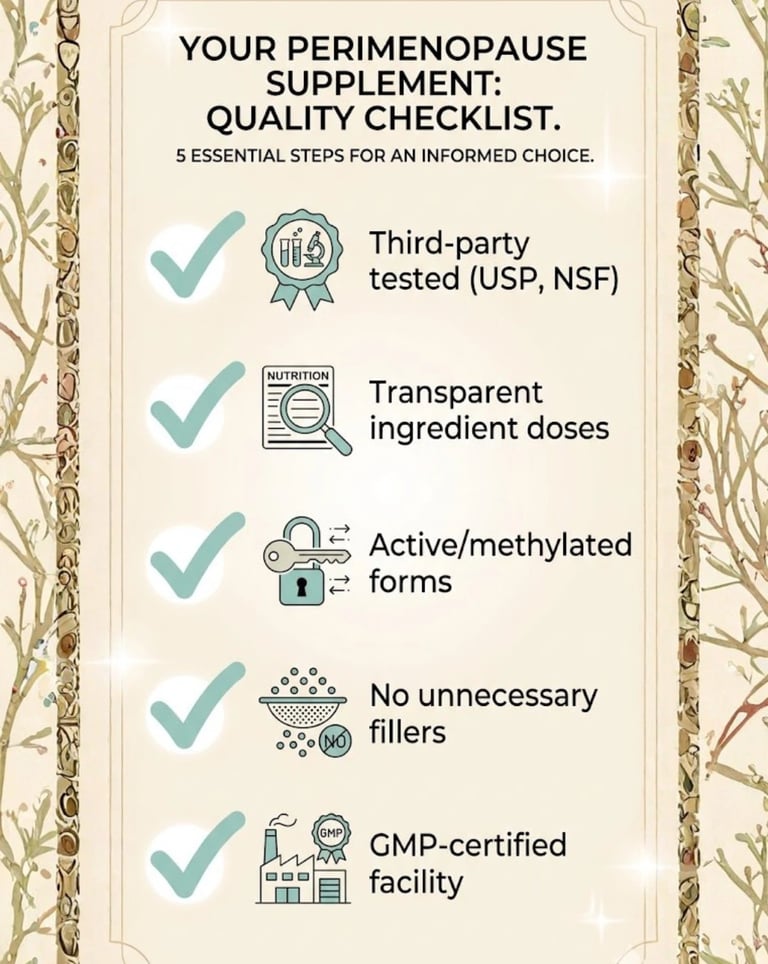
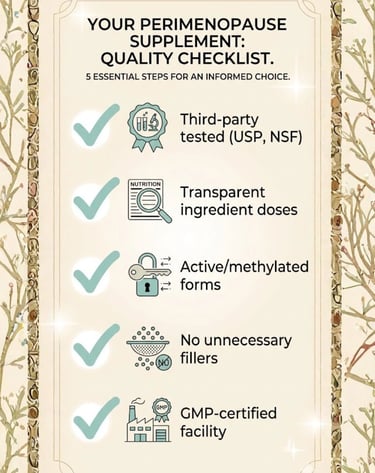
The supplement industry is a Wild West. Quality control is inconsistent, and what's on the label isn't always what's in the bottle. Protect yourself by looking for:
Third-party verification seals:
USP (United States Pharmacopeia) — rigorous testing for purity, potency, and manufacturing standards
NSF International — independent testing for contaminants and label accuracy
ConsumerLab — independent testing with published results
Informed Sport (for athletes concerned about banned substances)
Other quality indicators:
GMP (Good Manufacturing Practice) certification
Transparent ingredient lists with doses (not "proprietary blends")
Company willingness to share Certificates of Analysis (COAs)
Red Flags to Avoid
Be wary of supplements that:
Make dramatic health claims ("eliminates menopause symptoms!")
Use proprietary blends that hide individual doses
Contain artificial colors, fillers, or unnecessary additives
Are dramatically cheaper than comparable products (you often get what you pay for)
Come from companies with no verifiable contact information or testing standards
Should You Test Before You Supplement?
Which Nutrients Are Worth Testing
Testing isn't necessary for every supplement, but it's valuable for:
Working with Your Healthcare Provider
Bring your questions — and ideally, specific testing requests — to your provider. Not all practitioners are well-versed in nutrient deficiencies, so advocating for yourself may be necessary.
Helpful phrases:
"I'd like to check my vitamin D and B12 levels before starting supplements."
"I'm experiencing [specific symptoms] and want to rule out nutritional deficiencies."
"Can we include ferritin in my bloodwork, given my heavy periods?"
Testing transforms supplementation from guesswork into targeted intervention.
A Realistic Supplement Stack for Perimenopause
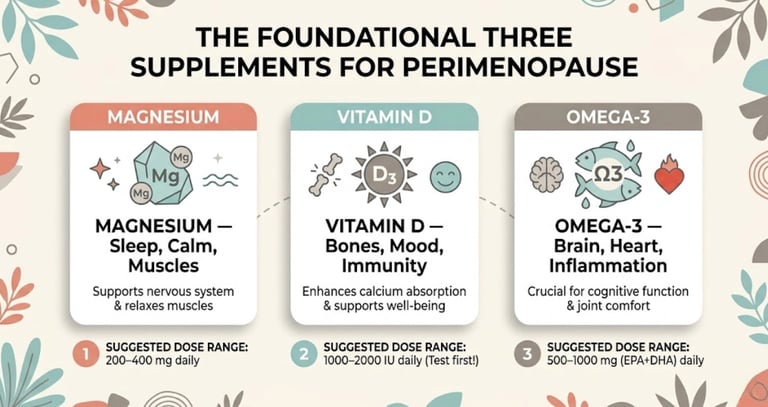
The Foundational Three
If you're going to start somewhere, these three nutrients offer the most consistent benefit for the broadest range of perimenopausal women:
This is not a prescription. It's a reasonable starting point that addresses the most common deficiencies and symptoms.
Adding Based on Your Symptoms
From the foundational three, consider additions based on your specific experience:
Build gradually. Start with one or two additions, assess for 4–6 weeks, then adjust. This approach helps you identify what's actually helping.
Frequently Asked Questions
What vitamins should I take during perimenopause?
The most evidence-backed options are magnesium (for sleep, mood, muscle tension), vitamin D (for bone and mood health), omega-3 fatty acids (for inflammation and brain function), and B vitamins (for energy and nerve health). Start with testing for deficiencies when possible.
Can vitamins help with perimenopause symptoms?
Yes — certain vitamins and minerals can meaningfully reduce specific symptoms. Magnesium supports sleep and reduces anxiety. Vitamin E may reduce hot flash severity. B12 supports energy and cognitive function. However, supplements work best as part of a comprehensive approach, not as standalone solutions.
What is the best supplement for perimenopause weight gain?
No supplement directly causes significant weight loss. However, magnesium (blood sugar regulation), omega-3s (inflammation reduction), and vitamin D (metabolic support) may support overall metabolic health. Addressing cortisol with adaptogens like ashwagandha may also help.
Should I take iron during perimenopause?
Only if you're deficient — and only confirmed by testing (ferritin + CBC). Women with heavy periods may need iron; women whose periods have lightened or stopped generally do not. Excess iron is harmful.
Are perimenopause supplements safe?
Most vitamins and minerals are safe at recommended doses. However, some (iron, vitamin E, vitamin A) can be harmful in excess. Herbal supplements can interact with medications. Always choose third-party tested products and consult a healthcare provider if you're on medications or have health conditions.
How long does it take for perimenopause supplements to work?
It varies by nutrient. Magnesium may improve sleep within days to weeks. Vitamin D takes weeks to months to restore levels. Omega-3s build up over 6–8 weeks. Herbal supplements typically need 4–8 weeks for assessment. Be patient and track your symptoms.
Supplements Are Tools — Not Magic Fixes
If you've read this far hoping for a pill that will make perimenopause disappear, here's the honest truth: it doesn't exist.
But targeted supplementation — based on your deficiencies, your symptoms, and good evidence — can genuinely help.
Magnesium can help you sleep. B12 can clear the fog. Omega-3s can quiet the inflammation. Vitamin D can lift the veil of fatigue and low mood that so many women describe.
These aren't miracles. They're nutrients your body needs more of during a time of profound hormonal change — nutrients that modern diets, chronic stress, and aging digestive systems often fail to provide.
Start with the basics. Test what's testable. Build gradually. Track your response.
And remember: supplements work best alongside the other pillars of perimenopausal health — sleep, movement, stress management, nutrition, and community.
You're not just throwing pills at a problem. You're giving your body what it needs to navigate this transition with more resilience, more clarity, and less suffering.
That's not snake oil. That's smart self-care.
Ready to take the next step?
(https://perimenopausecompass.com/free-14-day-tracker) to find your personal triggers.
Get the Perimenopause Nutrition Protocol to support your nervous system from the inside out.
Visit our (https://perimenopausecompass.com/start-here) page for more foundational guidance.
Get the Perimenopause Nutrition Protocol ($29 + bonus) → https://perimenopausecompass.gumroad.com/l/iecoc
______________________________________
Disclaimer Education only — not medical advice. Consult a qualified healthcare professional for diagnosis and treatment.
Sources / References
Perimenopause Compass
Contact
hello@perimenopausecompass.com
© 2026 All rights reserved.