Hot Flashes at Night vs Night Sweats: Key Differences
Moisture or heat? Learn the difference between hot flashes at night vs night sweats. Use our 14-day guide to track patterns and find calm perimenopause relief.
EDUCATIONAL
Perimenopause Compasss
1/30/20267 min read
Hot Flashes at Night vs Night Sweats: What’s the Difference?
If you have ever woken up in the middle of the night feeling like your core is radiating heat—or, conversely, feeling like you’ve just stepped out of a sauna into a cold room—you know how disruptive temperature changes can be. In the world of perimenopause, the terms "hot flashes" and "night sweats" are often used interchangeably. However, research increasingly shows that these two experiences, while related, have distinct characteristics and different impacts on your emotional well-being.
At Perimenopause Compass, we prefer to "track patterns, not perfection." Understanding whether you are experiencing sudden heat or drenching moisture is the first step in moving away from the frustration of "menopause brain" and toward a calm, evidence-informed management plan.
This post is for educational purposes only. It is not intended to diagnose or treat any medical condition. Because these shifts can be associated with a range of health factors, we always recommend talking to a qualified clinician about your specific experience. Today, we will explore the biological "glitch" behind these symptoms and provide you with a practical method to track your way back to better rest.
What hot flashes and night sweats look like
Both hot flashes and night sweats belong to a category of symptoms called vasomotor symptoms (VMS). They are the result of your body's internal cooling system overreacting to small changes in temperature. While they share a root cause, they present differently in your daily life.
Hot Flashes (at night)
A hot flash is primarily defined by a sudden, intense sensation of heat.
The Heat Wave: It usually starts in the chest, neck, or face and spreads rapidly through the upper body.
The Physical Response: You may notice your skin becoming red or blotchy (flushing), and your heart may begin to race (palpitations).
The Awakening: Interestingly, research shows that many women actually wake up a few seconds before a hot flash occurs, suggesting the brain's internal alarm triggers the awakening as part of the cooling process.
Night Sweats
A night sweat is technically a hot flash that occurs while you are asleep, but it is characterized by the volume of perspiration.
Drenching Moisture: Unlike a standard flash, night sweats produce copious, sometimes drenching perspiration that can soak through pajamas and sheets.
The "Chilly" Aftermath: Because the sweat evaporates quickly once you kick off the covers, it can cause a rapid drop in body temperature, leading to intense shivering or cold flashes as your body tries to warm back up.
Gradual Intensity: Night sweats often start more gradually and last longer than the sharp, short spike of a daytime hot flash.
Why it may happen (the clinical explanation)
To understand why you are waking up sweaty or hot, we have to look at the brain's "heat manager"—the hypothalamus.
In a body with steady hormone levels, the hypothalamus maintains a comfortable range called the thermoneutral zone. Within this zone, you don't sweat or shiver; you just feel "fine."
The Narrowing Zone: As estrogen levels fluctuate and decline during perimenopause, this thermoneutral zone narrows dramatically.
The Hair Trigger: With a narrowed zone, your body becomes hypersensitive to tiny increases in core temperature—sometimes as small as $0.8^\circ F$ ($0.4^\circ C$).
The False Alarm: The hypothalamus incorrectly perceives this tiny shift as dangerous overheating. In response, it triggers a massive "heat dissipation" sequence: blood vessels dilate (the flush) and sweat glands activate (the sweat) to cool you down immediately.
According to The Menopause Society (NAMS), up to 80% of women will experience these symptoms at some point during the transition, lasting an average of seven to ten years. For more on how these hormonal shifts interact with your daily clarity, read our guide on(https://perimenopausecompass.com/blog/perimenopause-brain-fog-symptoms-causes-solutions).
Key differences: Moisture, Duration, and Mood
Recent research presented to NAMS highlights that the distinction between hot flashes at night vs night sweats isn't just about laundry—it's about your mental health.
Women who experience frequent hot flashes specifically at night report higher scores for depressive symptoms, while those who deal with drenching night sweats tend to report significantly higher overall stress. This confirms that the sleep fragmentation caused by VMS is a major factor in perimenopause mood swings.
Common triggers worth tracking
While hormones provide the foundation for these symptoms, lifestyle "triggers" can push your body out of its narrow comfort zone. Tracking these in your(https://perimenopausecompass.com/blog/perimenopause-symptoms-checklist-14-day-tracking-guide) can reveal surprising patterns.
Alcohol: Even a single glass of red wine can dilate blood vessels and trigger a blood-sugar low during the night, both of which set off the hypothalamus.
Caffeine: Stimulants increase cortisol and can stay in your system for up to 10-12 hours, heightening your "heat sensitivity" at bedtime.
Spicy Foods: Ingredients like capsaicin physically raise core temperature, which a perimenopausal brain may over-interpret as a crisis.
Sugar & Processed Foods: Large, sugary meals before bed lead to glucose "rollercoasters" that can jolt the nervous system awake.
Stress: High levels of daytime anxiety "prime" the nervous system, making it more likely to overreact to temperature shifts at 3 a.m.
Environment: Synthetic pajama fabrics (like polyester) and heavy duvets trap heat against the skin, triggering the cooling response.
What to track for 14 days (simple daily log)
To move away from "guessing" and toward "knowing," use a simple scale of 0 to 3 for severity.
Heat Severity (0-3): 0 = none, 1 = mild warmth, 2 = intense heat, 3 = debilitating heat.
Moisture Level (0-3): 0 = dry, 1 = clammy, 2 = damp pajamas, 3 = needed to change sheets.
Sleep Impact: How many times did you wake up? Did you feel "wired" or "stressed" upon waking?
Trigger Check: Did you have alcohol, caffeine, or a late sugary dinner?
Cycle Phase: If you still have a cycle, are these symptoms worse the week before your period?
Download the free 14-day tracker
______________________________________
Disclaimer Education only — not medical advice. Consult a qualified healthcare professional for diagnosis and treatment.
Sources / References
What to try first (choose 1–2 changes only)
When your sleep is suffering, it is tempting to overhaul everything. We recommend choosing one environmental shift and one habit shift to see what works for your unique biology.
The "Natural Fiber" Reset: Switch to 100% cotton, linen, or bamboo sheets and pajamas. These fabrics breathe better than synthetics and help dissipate heat before it triggers a full-blown sweat.
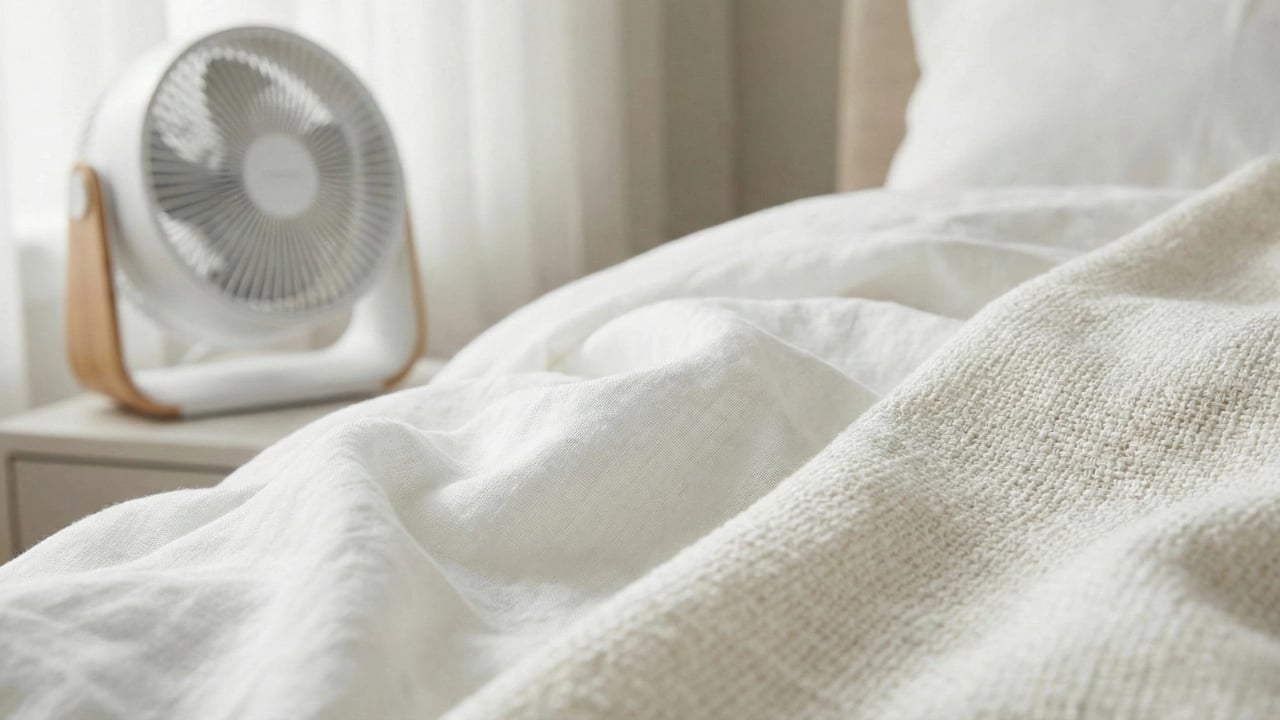
Optimize the "Thermostat": Set your bedroom to between $60^\circ F$ and $67^\circ F$. Use a bedside fan to keep air moving, which helps your skin stay within that narrow "thermoneutral zone."
The "Pillow Flip" Strategy: Keep a cold pack or a "Chillow" under your pillow. When you wake up feeling hot, flip the pillow to rest your face on a cold surface to quickly lower your temperature signal.
Blood Sugar Buffer: Try a small, protein-rich snack (like a few almonds) 30 minutes before bed to prevent the overnight glucose drops that trigger adrenaline spikes.
Pre-Sleep "Cool Down": A lukewarm shower before bed can help lower your core temperature and signal to your brain that it is time to rest.
For more strategies on managing middle-of-the-night awakenings, see our post on(https://perimenopausecompass.com/blog/perimenopause-insomnia-3am-wakeups).
A simple 7-day experiment (step-by-step)
This experiment helps you isolate a single variable to determine its impact on your night sweats perimenopause.
Days 1–2 (Baseline): Track your symptoms exactly as they are now.
Days 3–7 (The Test): Choose ONE trigger to remove (e.g., "No alcohol after 6 p.m.") OR one cooling habit to add (e.g., "Bedside fan on").
Measure Success: Look for a reduction in "Moisture Level" scores or a decrease in the time it takes to fall back asleep after a wake-up.
Evaluate: Did your "3/3" nights turn into "1/3" nights? Subtle progress is still progress!
Doctor-ready notes (bring this to your appointment)
Doctors appreciate objective data. Use this template to summarize your 14-day tracking:
"I am experiencing [hot flashes / night sweats] about [X] nights per week."
"My average moisture severity is a [1/2/3] out of 3."
"I have noticed my symptoms are most intense during [the week before my period / after high-stress days]."
"They are affecting my [work performance / mood / social life] in these ways: [X]."
Questions to ask your clinician:
Based on my tracker, does this look like perimenopause-related VMS?
Are there other conditions we should rule out, such as thyroid issues or iron deficiency?
What are the pros and cons of hormonal (like HRT) versus non-hormonal options for my specific symptom profile?
How do we monitor if these lifestyle changes are effective over the next month?
When to seek care sooner (red flags)
While hot flashes and sweats are a standard part of the transition, certain "red flags" warrant a quicker evaluation to rule out other causes.
Unexplained Weight Loss: Losing weight without trying.
Persistent Fever: If your sweats are accompanied by a high temperature or feeling "flu-ish" for more than two weeks.
Genuinely Drenching Sweats under age 40: If you are well outside the typical perimenopause window.
Swollen Lymph Nodes: Noticing lumps in the neck or armpits.
Chest Pain: If the heat is accompanied by tightness in the chest or difficulty breathing.
Frequently asked questions
How long do menopause night sweats typically last?
On average, vasomotor symptoms last between seven and nine years, though about one-third of women will continue to experience them for a decade or more. The intensity usually peaks about a year after your final period.
Does HRT help with both heat and moisture?
Yes. Hormone Replacement Therapy (HRT) is recognized by NAMS and ACOG as the most effective treatment for bothersome hot flashes and night sweats, with some studies showing a 75% reduction in frequency. However, the decision to use HRT is highly personal and should be discussed with a specialist.
Why do I feel anxious when a hot flash starts?
This is a physiological response. The same "glitch" that triggers your cooling system also triggers a small spike in adrenaline and norepinephrine. This can feel like a sudden "jolt" of anxiety or a panic attack just as the heat begins.
Can I have night sweats even if I still have regular periods?
Absolutely. Night sweats and hot flashes often begin during early perimenopause, while cycles are still regular, due to the initial erratic fluctuations in estrogen.
Conclusion
Whether you are dealing with the sharp heat of a hot flash or the drenching moisture of night sweats, remember that your body is simply navigating a profound biological transition. By focusing on tracking your patterns and implementing small, calm changes, you can begin to regain control of your rest.
Ready to start your foundational journey? Visit our(https://perimenopausecompass.com/start-here) page for more resources.
Download the free 14-day tracker
Perimenopause Compass
Contact
hello@perimenopausecompass.com
© 2026 All rights reserved.