Alcohol and Perimenopause Night Sweats: A Practical Guide
Does alcohol make night sweats worse? Learn the biological link, how to identify your triggers, and how to test your tolerance without quitting forever.
NUTRITION
Perimenopause Compasss
1/30/20267 min read
Does Alcohol Make Night Sweats Worse? How to Test It (Without Quitting Forever)
For many women, a glass of wine at the end of a long day has long been a symbol of relaxation. But as you enter your 40s, you might notice that the same "relaxing" glass of Pinot Noir results in a 3 a.m. wake-up call, accompanied by drenching pajamas and a racing heart. If you’ve started to suspect that your evening ritual is fueling your perimenopause night sweats, you are not alone—and you are not imagining it.
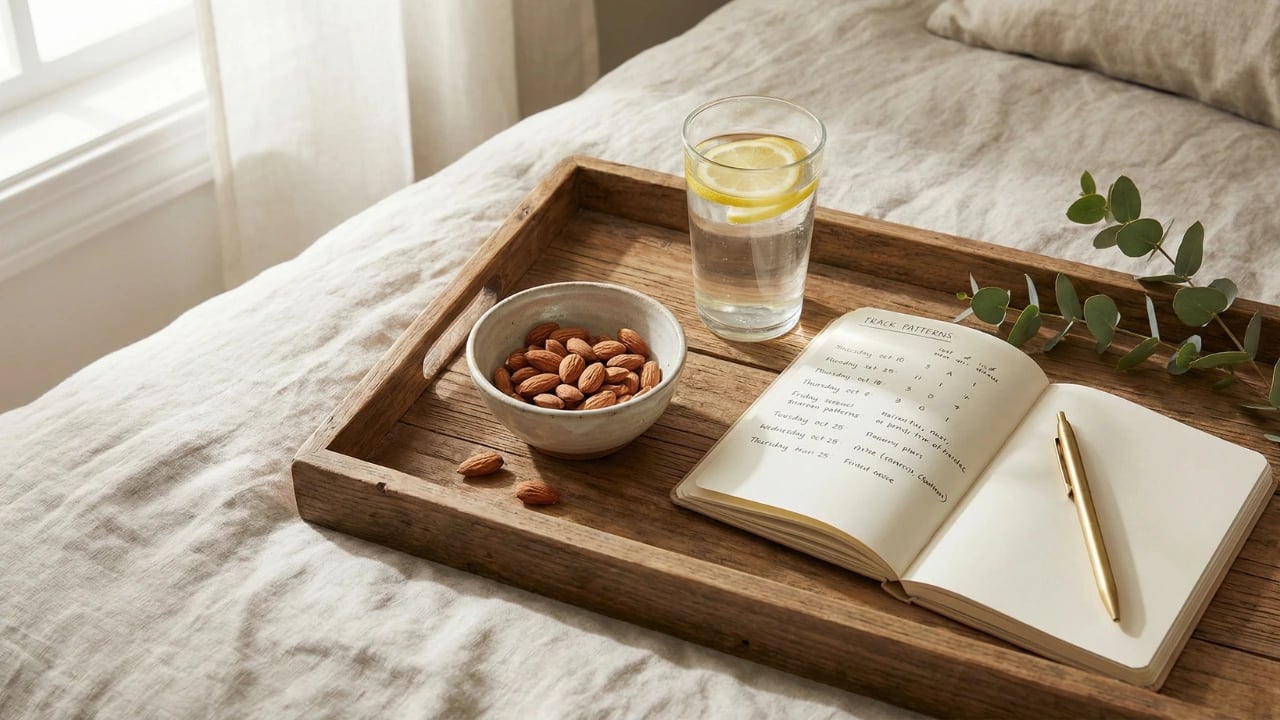
At Perimenopause Compass, we advocate for "tracking patterns, not perfection." Navigating the menopausal transition isn't about rigid rules or stripping away every joy; it’s about understanding how your changing biology responds to different variables. While alcohol is a known trigger for many, it doesn't always have to be an "all or nothing" situation.
This post is for educational purposes only and is not medical advice. It is not intended to diagnose or treat any condition. Because sleep disturbances and sweating can be associated with various health factors, always talk to a qualified clinician about your symptoms. Today, we will explore the science of why alcohol can turn up the heat and how you can run a simple experiment to find your own "middle ground."
What alcohol-triggered night sweats feel like
When alcohol triggers perimenopause night sweats, the experience often feels more intense than a standard hormonal flash. Many women describe it as a "sudden furnace" that switches on just a few hours after falling asleep.
The "Wine Flush": An intense wave of heat that starts in the chest and neck, often leaving the skin blotchy or red.
Drenching Perspiration: Unlike a mild warm flash, these episodes can be "soaking," requiring a change of sheets or pajamas.
Rapid Heartbeat: You may wake up feeling like your heart is pounding (palpitations) or experiencing a sense of mild panic.
The Chilly Aftermath: As the sweat evaporates, you may experience intense shivering or "cold flashes" as your body tries to warm back up.
Fragmented Sleep: Waking up frequently to change clothes or flip the pillow, making deep, restorative sleep nearly impossible.
These symptoms are part of what clinicians call "vasomotor symptoms" (VMS). They occur because your body’s cooling system is receiving faulty signals from the brain.
Why it happens (the science of the "Wine Flush")
To understand why a cocktail can trigger a sweat, we have to look at how alcohol interacts with your internal thermostat—the hypothalamus.
1. Vasodilation and Heat
Alcohol is a natural vasodilator, meaning it causes your blood vessels to widen. This brings more blood to the surface of the skin, creating a sensation of warmth and flushing. In a body with stable estrogen, this effect is mild. However, a perimenopausal brain has a "narrowed thermoregulatory zone". This means even a tiny increase in skin temperature—less than $1^\circ F$—can cause the hypothalamus to overreact and trigger a full-blown cooling response (a night sweat).
2. The Liver as a "Multitasker"
Your liver is responsible for both processing alcohol and metabolizing fluctuating hormones like estrogen. When you drink, the liver prioritizes clearing the alcohol—a toxin—from your system. This can delay the breakdown of hormones, leading to erratic spikes that may worsen vasomotor symptoms.
3. The Blood Sugar "Rollercoaster"
Alcohol can cause a "rebound" drop in blood sugar several hours after consumption. When blood sugar dips too low overnight, the body releases adrenaline and cortisol to stabilize itself. These stress hormones are powerful triggers for night sweats and 3 a.m. wake-ups.
According to the Cleveland Clinic, alcohol is one of the most common dietary triggers for bothersome menopause symptoms. For a deeper dive into the biology of temperature regulation, see our guide on the difference between hot flashes and night sweats.
Common triggers worth tracking
Not all drinks are created equal. Identifying which specific compounds "turn on the heat" for you is a key part of the "track patterns" approach.
Histamines: Fermented drinks like red wine and beer are high in histamines. As estrogen fluctuates, many women develop a new sensitivity to histamines, which can cause flushing, nasal congestion, and night sweats.
Sulfites: These preservatives are notoriously high in wine and can trigger allergy-like flushing in sensitive individuals.
Sugar Content: Sweet cocktails or dessert wines can cause a double-hit to your blood sugar, increasing the likelihood of an adrenaline spike at night.
Timing: Alcohol consumed within 3 hours of bedtime is much more likely to disrupt the REM sleep cycle and trigger a sweat.
Volume: As alcohol tolerance decreases in midlife, even "one glass too many" can lead to a two-day "hangover" of increased symptoms.
What to track for 14 days (simple daily log)
To move away from guessing and toward knowing, use a simple daily log for two weeks. Use a scale of 0 to 3 for severity (0 = none, 3 = drenching).
The Drink Type: Was it red wine, white wine, a clear spirit, or beer?
The Timing: How many hours before sleep did you have your last sip?
The "Sweat" Score (0–3): Did you wake up dry (0), clammy (1), or needing to change (3)?
Sleep Quality (1–5): How rested do you feel on a scale of 1 to 5?
3 a.m. Wake-up (Y/N): Did you wake up specifically in the early morning hours?
Stress Level (0–5): Was it a high-pressure day? (Stress and alcohol often "stack" to make symptoms worse).
If alcohol is one piece of the puzzle, meal timing and food choices can be another. The Perimenopause Nutrition Protocol is a calm 28‑day framework to lower inflammation load—without diet culture.
https://perimenopausecompass.gumroad.com/l/iecoc
A simple 7-day experiment (The curiosity approach)
You don't have to commit to quitting forever to get answers. This experiment is about curiosity, not deprivation.
Days 1–2 (Baseline): Drink and sleep as you normally would. Log your sweat severity and sleep quality.
Days 3–7 (The Variable Change): Choose ONE specific change. For example: "No alcohol for 5 days" or "Switch from red wine to a gin-and-tonic."
Keep Everything Else Stable: Try not to change your dinner time or exercise routine during these days.
Evaluate: At the end of the week, compare your scores. Did your "3/3" night sweat score drop to a "1/3"? Did you stop waking up at 3 a.m.?.
Mini Example Pattern:
Baseline: 2 glasses of Merlot at 8 p.m. → Sweat Score 3, Sleep Quality 1.
Experiment: No alcohol. → Sweat Score 1, Sleep Quality 4.
Observation: Red wine is a likely "heavy" trigger for my night sweats.
What to try first (The "Middle Way" options)
If you find that alcohol is a trigger but you aren't ready to give it up entirely, try these "harm reduction" strategies to see if they help you stay within your thermoneutral zone.
The "Spritzer" Shift: Mix your wine with equal parts sparkling water. This lowers the alcohol by volume (ABV) and improves your hydration levels.
Clear Spirit Test: Some women find that clear spirits (like vodka or gin) with a low-sugar mixer (like soda and lime) are less triggering than histamine-heavy wine or beer.
The 3-Hour Buffer: Aim to finish your last drink at least 3 hours before you head to bed. This gives your liver a "head start" on processing the alcohol before you enter deep sleep.
Hydration Stacking: Drink one full glass of water for every alcoholic beverage. This helps prevent the dehydration that makes alcohol-related flushing worse.
The Protein Buffer: Never drink on an empty stomach. Pair your drink with a protein-rich snack to help stabilize the blood sugar response.
Explore "Zero-Proof": Many modern non-alcoholic wines and spirits are high-quality and allow you to keep the "ritual" without the biological heat spike.
For more on managing the 3 a.m. wake-ups that often follow an evening drink, read our related post on perimenopause insomnia and middle-of-the-night waking.
Doctor-ready notes (bring this to your appointment)
When you discuss your symptoms with a clinician, having objective data makes the conversation more productive.
Copy and Fill-in:
"I've noticed my night sweats are most severe on nights when I have."
"On those nights, I rate my moisture severity as [1/2/3] out of 3."
"I typically wake up at and struggle to return to sleep for [X] minutes."
"I tried [Change, e.g., switching to clear spirits] and noticed [X] result."
Questions to ask your clinician:
Could my changing alcohol tolerance be related to perimenopausal liver function or enzyme levels?
Are there other conditions we should rule out, such as blood sugar instability or thyroid issues?
Based on my log, do these seem like standard vasomotor symptoms or something more severe?
Would you recommend testing my fasting glucose or liver enzymes?
Are there non-hormonal or hormonal options that might help stabilize my "thermostat" while I work on lifestyle shifts?
When to seek care sooner (red flags)
While night sweats triggered by alcohol are a common part of midlife, certain "red flags" mean you should contact your healthcare provider or visit urgent care sooner for a thorough assessment.
Unexplained Weight Loss: Losing weight without trying while experiencing sweats.
Persistent Fever: If your night sweats are accompanied by a high temperature or feeling "flu-ish" for more than two weeks.
Drenching Sweats under age 40: If you are well outside the typical perimenopause window.
Swollen Lymph Nodes: Noticing lumps in the neck, armpits, or groin.
Pain after drinking: If you experience actual physical pain (not just flushing) immediately after consuming alcohol.
Chest Pain: If the heat is accompanied by difficulty breathing or tightness in the chest.
Frequently asked questions
Does HRT make it safe to drink again?
Hormone Replacement Therapy (HRT) is the most effective treatment for vasomotor symptoms. Many women find that once their hormones are stabilized, their "thermostat" becomes less reactive to triggers like alcohol. However, alcohol can still disrupt sleep quality regardless of HRT status, so tracking your patterns is still recommended.
Why did I used to be able to drink wine without any issues?
During perimenopause, your body composition changes (often less muscle and more body fat), and your liver enzymes may become less efficient at processing alcohol. Additionally, the loss of the "progesterone brake" makes your nervous system more sensitive to the stimulating effects of alcohol.
Is beer better than wine for night sweats?
Possibly. One small study suggested that the phytoestrogens in beer might have a slight protective effect for some women. However, beer is also high in histamines and carbs, which can trigger symptoms in others. Your 14-day log will tell you which is true for your body.
Can alcohol cause permanent damage to my sleep cycle?
No, but chronic use can lead to a "vicious cycle" where poor sleep increases anxiety, which leads to more drinking for "relaxation," further disrupting sleep. Breaking the cycle with a 7-day experiment can help reset your sleep architecture.
Should I track my cycle if my periods are irregular?
Yes. Many women find they are much more sensitive to alcohol during the week before their period when estrogen is at its lowest. Knowing your cycle phase can help you decide when you might need to be more careful with triggers.
Conclusion
Navigating perimenopause night sweats is about reclaiming your agency, not about shame or restriction. By using a calm, curious approach to your habits and focusing on "tracking patterns, not perfection," you can discover exactly what your body needs to stay cool and rested.
Ready to take the first step toward more clarity? Visit our(https://perimenopausecompass.com/start-here) page to build your foundational plan today.
______________________________________
Disclaimer Education only — not medical advice. Consult a qualified healthcare professional for diagnosis and treatment.
Sources / References
Perimenopause Compass
Contact
hello@perimenopausecompass.com
© 2026 All rights reserved.