
Perimenopause Anxiety at Night: 5-Minute Calming Routines
Struggling with racing thoughts? Learn why perimenopause anxiety at night happens and discover quick, habit-stacked routines to calm your nervous system.
EDUCATIONAL
Perimenopause Compasss
1/30/20268 min read
Perimenopause Anxiety at Night: Calming Routines That Actually Fit Busy Schedules
If you have ever been fast asleep only to be jolted awake at 3 a.m. by a sudden wave of dread, or if you find yourself lying in the dark with your mind spinning over a comment you made three days ago, you are experiencing one of the most common—yet least discussed—challenges of the menopausal transition. Perimenopause anxiety at night can feel like a "wired but tired" state where your body is exhausted, but your brain refuses to hit the brakes.
At Perimenopause Compass, we focus on "tracking patterns, not perfection." For a busy woman juggling a career, family, and a changing body, the idea of an hour-long meditation may feel like just another chore on an already full to-do list. The good news is that managing nighttime anxiety perimenopause doesn't require a total life overhaul. It requires small, consistent shifts that work with your biology rather than against it.
This post is for educational purposes only and does not serve as a medical diagnosis or treatment plan. It is important to talk to a qualified clinician about your symptoms, especially if they are affecting your daily functioning. Our goal is to provide you with evidence-informed education and practical tools to help you navigate these racing thoughts at night with a sense of calm and agency.
What perimenopause anxiety at night can look like
Anxiety during perimenopause isn't always a classic "panic attack." It can manifest as a subtle, persistent hum of unease or a series of physical sensations that are easy to mistake for other issues.
Common experiences include:
The "3 a.m. Adrenaline Jolt": Waking up suddenly with a racing heart, often accompanied by a sense of impending doom.
Intrusive or Catastrophic Thinking: Finding it impossible to "turn off" your thoughts, which often spiral into "what-if" scenarios.
Physical Tension: Clenched jaws, tight shoulders, or a "nervous stomach" that prevents you from settling into deep rest.
Sensory Overload: Feeling suddenly overwhelmed by noise, light, or even the texture of your sheets.
Formication: A lesser-known symptom where it feels like tiny insects are crawling on or under your skin, which can trigger feelings of panic.
Sleep Maintenance Insomnia: You may fall asleep easily but struggle to stay asleep, waking up frequently to find your mind immediately "switched on".
Why it happens (simple, high-level)
The shift in your hormone levels and anxiety are deeply connected. Your brain is a hormone-sensitive organ, and the erratic fluctuations of perimenopause affect the very chemicals that keep you feeling steady.
The Progesterone-GABA Connection: Progesterone is often called the brain’s "natural valium." It converts into a neurosteroid that boosts GABA, your primary inhibitory neurotransmitter that acts like a "brake pedal" for the nervous system. As progesterone declines earlier and more sharply than estrogen, that calming brake pedal weakens, leading to irritability and anxiety.
Estrogen and Serotonin: Estrogen helps regulate serotonin (the "happy hormone") and dopamine. When estrogen levels fluctuate and fall, serotonin processing is impacted, which can result in sudden mood swings or a feeling of being emotionally overstimulated.
The Cortisol Spike: Cortisol is your primary stress hormone. During perimenopause, the HPA axis (the body's stress response system) becomes more reactive. Cortisol should naturally be low at night, but hormonal shifts can cause it to spike prematurely around 3 a.m., pulling you out of deep sleep and into an alert, anxious state.
Blood Sugar Dips: If your blood sugar drops too low overnight, your body releases adrenaline and cortisol to compensate, which can wake you up feeling jittery or panicked.
Reference: The North American Menopause Society (NAMS).
Common triggers/patterns worth tracking
Identifying your personal triggers is the first step toward reclaiming your peace. Start by noticing how these factors influence your nighttime anxiety perimenopause:
Alcohol Timing: While it may help you fall asleep, alcohol disrupts sleep architecture and can trigger a blood sugar "crash" later in the night.
Caffeine Cutoff: Caffeine is a stimulant that can stay in your system for 10–12 hours. Even a mid-day coffee can heighten cortisol levels at bedtime.
Late/Heavy Dinner: Large meals, particularly those high in refined sugar, can cause glucose fluctuations that trigger adrenaline spikes during sleep.
Spicy Food: These can raise your core temperature, making you more sensitive to night sweats, which in turn spikes anxiety.
Stress Day Rating: Tracking the overall "pressure" of your day helps you see how daytime stress bleeds into nighttime racing thoughts.
Warm Bedroom: A temperature above 68°F can act as a stressor for a perimenopausal body that is already struggling with temperature regulation.
Screen/Light Exposure: Blue light suppresses melatonin and keeps your brain in "active" mode.
Cycle Phase: Many women find that anxiety peaks during the "low hormone" window just before their period starts.
What to track for 14 days (simple daily log)
To move away from "guessing" why you feel anxious, use a 14-day tracking method. This data helps you identify patterns so you can make informed choices with your doctor.
Evening Check-in Checklist:
Anxiety/Worry Level (0–3): 0 = calm, 1 = mild/noticeable, 2 = moderate/distracting, 3 = severe/panicked.
Sleep Quality (1–5): 1 = poor/unrefreshing, 5 = excellent.
Nighttime Awakenings (Y/N): Did you wake up specifically between 2 a.m. and 4 a.m.?
Racing Thoughts (0–3): How difficult was it to "quiet" your mind?
Trigger Check: Did you have caffeine after noon? Alcohol after 6 p.m.? A high-sugar dinner?
Stress Rating (0–5): How much external pressure did you feel today?
Movement: Did you get at least 10–20 minutes of gentle activity?
Cycle Day: What day of your cycle are you on? (Day 1 is the first day of your period).
By using these scales (0–3 for severity and 1–5 for quality), you can quickly visualize trends without spending more than two minutes on your log.
If anxiety at night comes with cravings, energy crashes, or late snacking, a steady meal structure can help you feel more supported. The Perimenopause Nutrition Protocol gives you a calm 28‑day plan + Peri‑Plate bonus.
https://perimenopausecompass.gumroad.com/l/iecoc
What to try first (choose 1–2 changes only)
For a busy schedule, the goal is "micro-habits" that take five minutes or less. Choose one or two of these natural remedies for perimenopause anxiety to test this week:
The 4-7-8 Breathing Reset: Inhale for 4, hold for 7, exhale for 8. This signals your parasympathetic nervous system to "stand down." Try just three rounds before bed or when you wake up anxious.
Blood Sugar Buffer Snack: Try a small, protein-rich snack (like a few almonds or a boiled egg) 30 minutes before bed to prevent the nighttime glucose dips that trigger cortisol.
The 5-4-3-2-1 Sensory Reset: If your mind is racing, name 5 things you see, 4 you can touch, 3 you hear, 2 you smell, and 1 you taste. This anchors you in the present moment.
Temperature "Safe Signal": If you feel panic rising, splash cold water on your face or run it over your wrists for 30 seconds. This activates the mammalian dive reflex, which naturally slows your heart rate.
The "Brain Dump": Keep a notebook by your bed. If thoughts are spinning, write them all down to get them "out of your system." You can even resolve to address them at a set time tomorrow.
Caffeine Cutoff Test: Move your last cup of coffee to before 10 a.m. to see if it reduces your nighttime "edge".
Magnesium Relaxation: Many women find that a magnesium glycinate supplement helps support the GABA system and promotes relaxation (consult your doctor for the right approach for you).
For more on managing physical symptoms that can trigger anxiety, see our guide on (https://perimenopausecompass.com/blog/perimenopause-night-sweats-why-they-happen-how-to-manage).
A simple 7-day experiment (step-by-step)
This experiment uses habit stacking—attaching a new calming habit to something you already do on autopilot.
Days 1–2 (Baseline): Track your anxiety and sleep as they are now.
Days 3–7 (The Habit Stack): Choose one "anchor" habit you already have and stack a 2-minute regulation tool on top of it.
Example Stacks:
While your evening tea is steeping → Practice 2 minutes of 4-7-8 breathing.
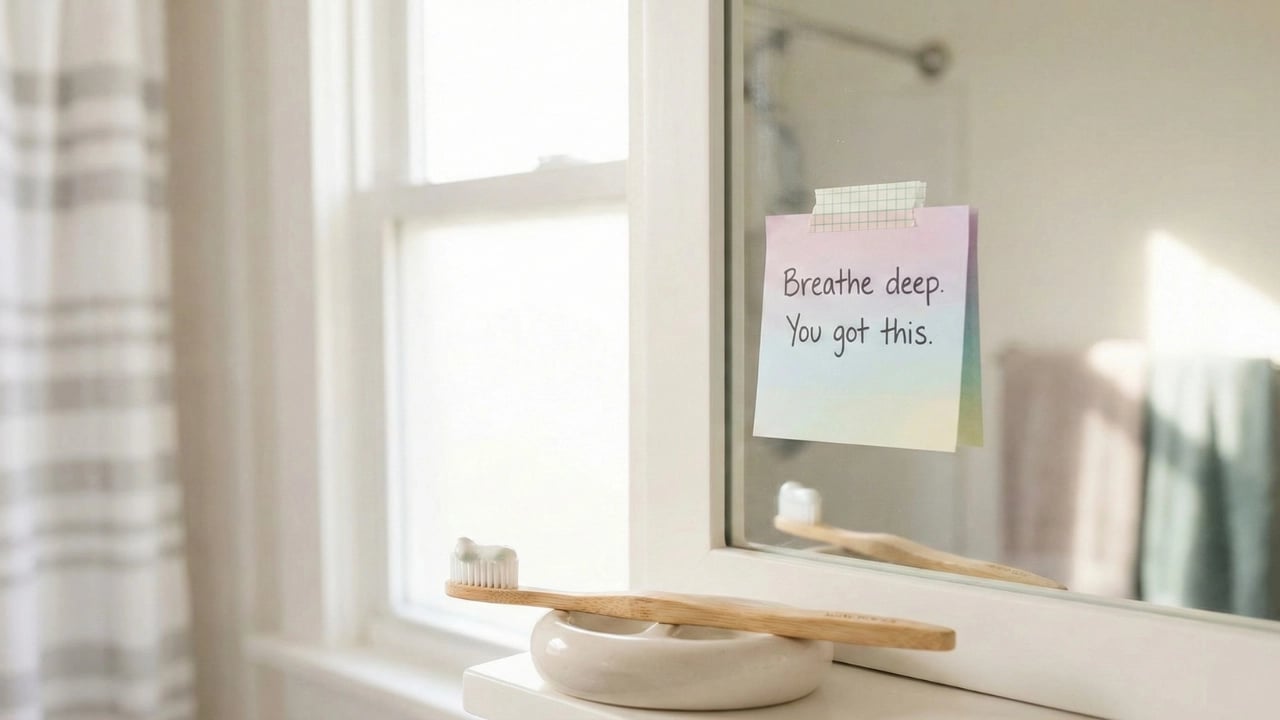
While you are brushing your teeth → Repeat a calming affirmation or do a 1-minute gratitude check.
After you turn off your bedside lamp → Practice a "butterfly hug" (crossing arms and tapping shoulders alternately) to settle your nervous system.
Evaluate: Look at your 14-day tracker. Did your anxiety score drop? Did your sleep quality improve?
______________________________________
Disclaimer Education only — not medical advice. Consult a qualified healthcare professional for diagnosis and treatment.
Sources / References
For more foundational steps on managing the transition, visit our (https://perimenopausecompass.com/start-here) page.
Doctor-ready notes (bring this to your appointment)
When discussing perimenopause mood swings and anxiety with your clinician, having data makes the conversation much more productive.
Copy and Fill-in:
Top Symptoms: "I am experiencing [racing thoughts / racing heart / panic] specifically at [time of day/night]."
Frequency: "This is happening [X] nights per week."
Impact: "It is affecting my [work / family life / ability to drive safely]."
Observed Patterns: "I noticed my anxiety peaks [the week before my period / after drinking caffeine]."
Questions to Ask Your Clinician:
Could my nighttime anxiety be related to the hormonal shifts of perimenopause?
Are there other conditions we should rule out, such as thyroid dysfunction or iron-deficiency anemia?
Based on my trigger log, what is your recommended first step for management?
What are the pros and cons of hormonal (like HRT) versus non-hormonal options for my specific anxiety profile?
If lifestyle shifts aren't enough, what are my options for mental health support?
If you are also experiencing mental fatigue, you may find our post on (https://perimenopausecompass.com/perimenopause-brain-fog-symptoms-causes-solutions) a helpful companion guide.
When to seek care sooner (red flags)
While anxiety during perimenopause is common, some symptoms require more immediate medical evaluation. Please contact your doctor or urgent care if you experience:
Anxiety that makes it impossible to perform daily hygiene, eat, or go to work.
Sudden, intense chest pain or shortness of breath (always rule out cardiac causes first).
Suicidal thoughts or feelings of profound hopelessness.
Fainting or severe dizzy spells.
Rapid memory loss or disorientation.
New, severe panic attacks that occur without a clear trigger.
Frequently asked questions
Is waking up at 3 a.m. always a sign of anxiety?
Not always, but it often is in perimenopause. While a hot flash might wake you up physically, the premature spike in cortisol and the drop in progesterone can cause your brain to enter an "alert" mode, which we experience as perimenopause anxiety at night.
How long does perimenopause anxiety last?
For many women, anxiety symptoms tend to peak during the late perimenopausal stage when hormone fluctuations are most extreme. Most find that as they transition into postmenopause and their hormone levels reach a new, steady baseline, the intensity of the anxiety decreases.
Do night sweats cause racing thoughts?
There is a "vicious cycle" here. A night sweat is a physical stressor that can trigger your nervous system's fight-or-flight response, leading to racing thoughts at night. Conversely, an anxious thought can trigger a hot flash by stimulating the hypothalamus.
What is the best "quick win" for a busy schedule?
The 4-7-8 breath or the 5-4-3-2-1 grounding technique are the fastest ways to regulate your nervous system. They take less than two minutes and can be done anywhere, even in bed.
Should I track my cycle even if it's irregular?
Yes. Tracking even irregular periods perimenopause can help you see if your anxiety clusters around specific hormonal windows, which is vital information for your healthcare provider.
When should I consider HRT for anxiety?
If your anxiety is significantly impacting your quality of life and is clearly tied to other perimenopause symptoms (like night sweats), hormone replacement therapy may help by stabilizing the hormonal environment. This is a personal decision to discuss with a Menopause Society Certified Practitioner.
Conclusion
Navigating perimenopause anxiety at night can be exhausting, but remember: your nervous system isn't broken; it's simply reacting to a profound biological shift. By starting small with a calming nighttime routine and tracking your patterns, you can begin to turn down the volume on those racing thoughts.
Ready to take the first step? (https://perimenopausecompass.com/free-14-day-tracker) and start identifying your triggers today. For a deep dive into all your symptoms, check out our (https://perimenopausecompass.com/blog/perimenopause-symptoms-checklist-14-day-tracking-guide).
Sources / References
Download the free 14-day tracker
Perimenopause Compass
Contact
hello@perimenopausecompass.com
© 2026 All rights reserved.