Peri-Plate Method: A Simple Meal Plan for Perimenopause
The Peri-Plate Method makes perimenopause nutrition simple. Learn how to build every meal around hormonal balance, stable energy, and foods that actually help your symptoms.
Perimenopause Compasss
2/11/20267 min read


You've read the articles. Cut the sugar. Eat more soy. Try Mediterranean. Go anti-inflammatory. Add flaxseeds. Avoid gluten. Drink more water. Eat less. Eat more. Eat differently.
If you're overwhelmed by nutrition advice right now — you're not the problem. The information landscape is the problem.
Your body is changing. Your hormones are shifting. And the way you eat probably needs to shift too. But you don't need another complicated diet plan. You need a framework that's simple enough to use every day — and specific enough to actually support your body through perimenopause.
That's what the Peri Plate Method is.
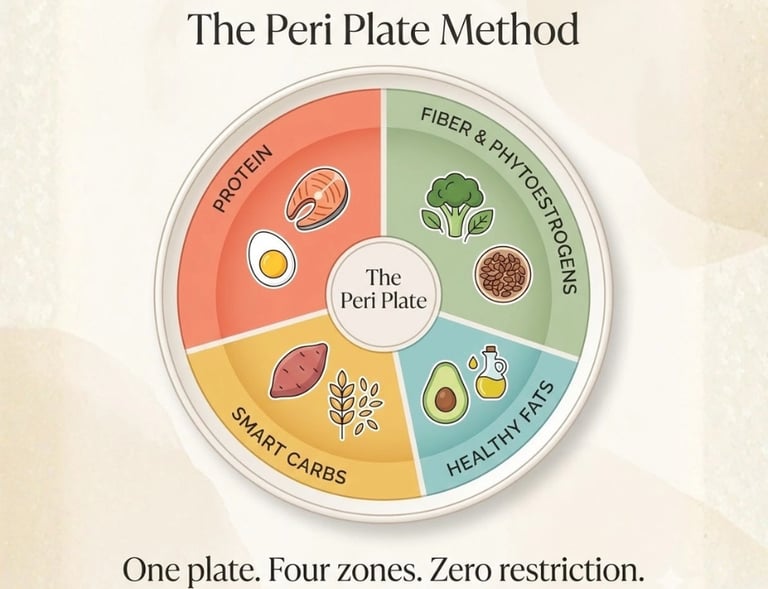
One plate. Four zones. No calorie counting. No food guilt. Just a clear, evidence-informed structure that helps you build meals around what your body actually needs right now — more protein, stable blood sugar, anti-inflammatory nutrients, and the building blocks your hormones require to function.
This isn't a diet. It's a way of thinking about food that works with your changing biology instead of against it.
Why Nutrition Changes During Perimenopause
Before we get into the method, it helps to understand why what you eat matters more — and differently — during this transition.
What Happens to Your Metabolism When Hormones Shift
Perimenopause doesn't just affect your periods and your mood. It fundamentally changes how your body processes, stores, and uses energy.
Here's what's happening under the surface:
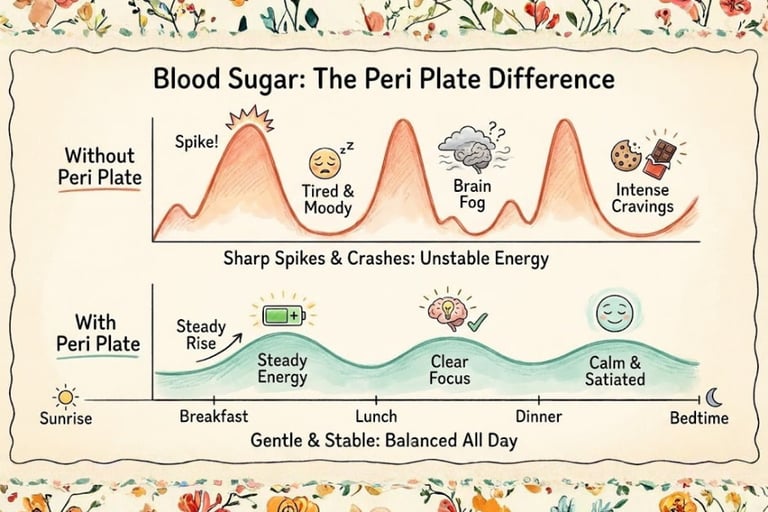
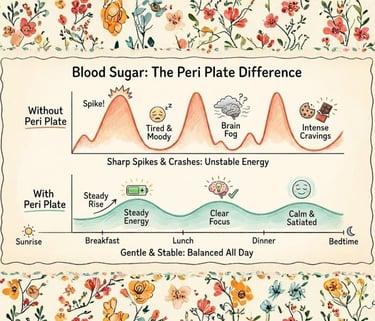
Estrogen influences insulin sensitivity. As estrogen fluctuates, your cells become less efficient at using glucose for energy. The result: more blood sugar spikes and crashes, more cravings, more fatigue.
Muscle mass begins to decline. Without adequate protein and resistance training, women lose approximately 3–8% of muscle mass per decade after 30 — and the rate accelerates during the menopausal transition. Less muscle means a slower resting metabolism.
Cortisol becomes more reactive. Your stress response system is more easily triggered during perimenopause. And cortisol directly affects where your body stores fat (hello, midsection), how well you sleep, and how hungry you feel.
Inflammation increases. Estrogen has anti-inflammatory properties. As levels become unstable, many women experience a low-grade inflammatory state that contributes to joint pain, brain fog, fatigue, and bloating.
None of this means you're doing something wrong. It means your body's operating system has updated — and your nutrition strategy needs to update with it.
Why the Diet That Worked at 30 Doesn't Work at 45
This is one of the most frustrating realizations of perimenopause: what used to work simply doesn't anymore.
Skipping meals used to feel fine. Now it leads to crashes, irritability, and brain fog.
A quick bowl of pasta used to be neutral. Now it's followed by bloating and an energy slump.
You could "eat less and move more" and see results. Now that equation feels broken.
This isn't a failure of willpower. It's biology. Your body now requires more protein, more nutrient density, and more blood sugar stability than it did a decade ago. Understanding this is the first step toward eating in a way that actually feels good again.
The Blood Sugar–Hormone Connection Most Women Miss
Here's a connection that doesn't get enough attention:
Unstable blood sugar makes perimenopause symptoms worse.
When blood sugar spikes and crashes — from skipping meals, eating refined carbs in isolation, or relying on caffeine and sugar for energy — your body releases cortisol to compensate. That cortisol:
Worsens hot flashes and night sweats
Increases anxiety and irritability
Disrupts sleep
Promotes visceral fat storage
Creates a cycle of cravings and fatigue
One of the most impactful things you can do for your perimenopause symptoms isn't adding a supplement — it's stabilizing your blood sugar through how you build your meals.
And that's exactly what the Peri Plate Method is designed to do.
What Is the Peri Plate Method?
The Concept — One Plate, Four Zones, Zero Restriction
The Peri Plate Method is a visual meal-building framework specifically designed for women in perimenopause. It's inspired by evidence-based nutrition principles — including the Harvard Healthy Eating Plate — but adapted for the unique metabolic, hormonal, and inflammatory needs of women in their 40s and 50s.
The idea is simple: every time you build a meal, you fill four zones on your plate.
Why this works: Turkey and chicken are rich in tryptophan, which — combined with a modest serving of carbohydrates — supports serotonin and melatonin production for better sleep. The lighter carb portion prevents nighttime blood sugar instability.
Snacks — The Bridge Strategy
Snacks aren't required, but if you need one, apply the Peri Plate principle in miniature: combine protein or fat with fiber.
Peri Plate Snack Ideas:
Apple slices + 2 tablespoons almond butter
Handful of walnuts + a few squares of dark chocolate (70%+)
Hummus + cucumber and bell pepper sticks
Greek yogurt + berries + 1 tsp ground flaxseed
Small handful of edamame with sea salt
Cottage cheese + cherry tomatoes
Avoid: Snacking on refined carbs alone (crackers, biscuits, granola bars with added sugar) — this creates the exact blood sugar spike-crash cycle you're trying to prevent.
Foods to Prioritize During Perimenopause
The Peri Plate Power Foods List
These are the foods that come up again and again in perimenopause nutrition research. You don't need all of them every day — but building a rotation around these categories gives your body the best possible nutritional support:
🐟 Omega-3 Rich Foods
Wild salmon, sardines, mackerel, anchovies
Walnuts, chia seeds, hemp seeds, ground flaxseed
Why: Anti-inflammatory, brain-protective, mood-stabilizing
🥚 High-Quality Protein
Eggs, chicken, turkey, lean beef, fish
Tofu, tempeh, lentils, beans, edamame
Greek yogurt, cottage cheese
Why: Muscle preservation, blood sugar stability, neurotransmitter support
🥦 Cruciferous Vegetables
Broccoli, cauliflower, Brussels sprouts, cabbage, kale, bok choy
Why: Support estrogen metabolism, contain DIM (diindolylmethane), rich in fiber
🫘 Phytoestrogen Sources
Ground flaxseed, soy (tofu, tempeh, edamame), chickpeas, sesame/tahini
Why: Gentle hormonal modulation, fiber, protein
🫐 Antioxidant-Rich Berries
Blueberries, strawberries, raspberries, blackberries
Why: Low glycemic, anti-inflammatory, neuroprotective
🥑 Hormone-Building Fats
Avocado, extra virgin olive oil, nuts, seeds, fatty fish
Why: Hormone production, brain health, joint support
🧄 Gut-Supporting Foods
Garlic, onions, leeks (prebiotic)
Sauerkraut, kimchi, kefir, yogurt, miso (probiotic)
Why: Estrobolome health, digestion, immune function
🦴 Bone-Supporting Nutrients
Calcium: dairy, sardines (with bones), fortified plant milk, leafy greens
Vitamin D: fatty fish, egg yolks, sunlight, supplementation if needed
Magnesium: pumpkin seeds, dark chocolate, almonds, spinach
Why: Bone density declines with estrogen loss — nutritional support starts now
Foods to Minimize (Without Guilt)
What Tends to Make Symptoms Worse — And Why
This isn't a "never eat" list. It's a "be aware" list. These foods and substances can amplify perimenopause symptoms for many women — but the degree varies individually.
______________________________________
Disclaimer Education only — not medical advice. Consult a qualified healthcare professional for diagnosis and treatment.
Sources / References
Get the Perimenopause Nutrition Protocol ($29 + bonus)
Get the Perimenopause Nutrition Protocol ($29 + bonus)
The nuanced truth: You don't have to eliminate any of these completely (unless you want to or your doctor advises it). But reducing them — especially alcohol and refined sugar — often produces noticeable symptom improvement within 2–4 weeks.
A note on alcohol: This is the one most women don't want to hear. But the research is consistent — even moderate alcohol consumption (1 drink per day) is associated with worsened vasomotor symptoms, poorer sleep quality, and increased breast cancer risk during the menopausal transition. You don't have to quit. But experimenting with less can be revealing.
How to Start the Peri Plate Method Today
Week 1 — The One-Meal Experiment
Don't overhaul everything at once. Start with one meal per day.
Choose the meal that's currently the most unstructured or carb-heavy — for most women, that's breakfast or lunch — and rebuild it using the four zones.
Your only goal for Week 1:
One Peri Plate meal per day. Every day. For seven days.
That's it. Notice how you feel after that meal compared to your usual option.
Week 2–4 — Building the Habit
Once one meal feels natural, expand:
Week 2: Apply the Peri Plate to a second meal
Week 3: Upgrade your snacks using the protein + fiber principle
Week 4: All three meals are Peri Plate–structured most days
By the end of the month, you'll have built a sustainable pattern — not through willpower, but through a structure that becomes second nature.
Common Mistakes to Avoid
❌ Trying to be perfect. The Peri Plate is a guideline, not a rule. Some meals won't have all four zones. That's fine.
❌ Under-eating. This method is about nourishment, not restriction. If you're hungry, you probably need more protein or fat — add more.
❌ Skipping protein at breakfast. This is the single most impactful change for most women. Don't start your day with carbs alone.
❌ Fearing carbs entirely. Very low-carb diets can worsen sleep, mood, and thyroid function during perimenopause. Include smart carbs — just pair them with protein and fat.
❌ Ignoring your body's signals. If a food makes you feel worse — even if it's on the "power foods" list — listen to your body. Individuality matters.
The Peri Plate Method Is Not a Diet — It's a Framework
Diets come with rules, timelines, and the implication that you're not enough as you are.
The Peri Plate Method comes with a structure, flexibility, and the understanding that your body is navigating a significant biological transition — and it deserves to be well-fed, not punished.
There's no "falling off" the Peri Plate. There's no Day 1 restart. There's no guilt.
There's just a plate with four zones. And every meal is a new opportunity to fill it.
Your body is changing. Let your plate change with it.
FAQ — The Peri Plate Method
Q: What is the Peri Plate Method?
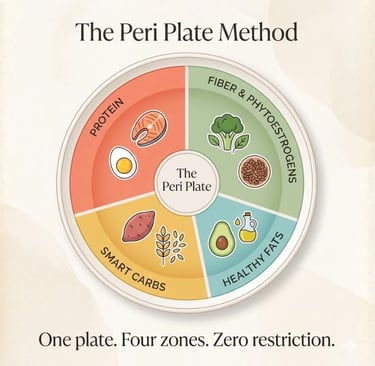
A: The Peri Plate Method is a simple meal-building framework for women in perimenopause. Each meal is built around four zones: protein (⅓), fiber-rich vegetables and phytoestrogens (⅓), complex carbs (¼), and healthy fats — designed to stabilize blood sugar and support hormonal balance.
Q: How much protein do I need during perimenopause?
A: Research suggests women over 40 benefit from 1.2–1.6 grams of protein per kilogram of body weight daily, spread across meals. Aim for 25–35 grams per meal to support muscle preservation and blood sugar stability.
Q: What foods help perimenopause symptoms?
A: Anti-inflammatory foods like fatty fish, leafy greens, and berries, plus protein-rich foods, ground flaxseed, soy, and fiber-rich vegetables can help reduce symptoms. Consistent blood sugar management through balanced meals has the most noticeable impact.
Q: Can diet really reduce hot flashes?
A: Evidence suggests that anti-inflammatory eating patterns, stable blood sugar, reduced alcohol, and moderate phytoestrogen intake may help reduce hot flash frequency and severity for some women, though results vary individually.
Q: Is the Peri Plate Method a weight loss plan?
A: No. The Peri Plate Method focuses on nourishment, hormonal support, and symptom management — not calorie restriction. Some women experience body composition changes as a side effect of better nutrition, but weight loss is not the primary goal.
Q: Should I avoid carbs during perimenopause?
A: No. Complex carbohydrates support serotonin production, sustained energy, and gut health. Very low-carb diets may worsen mood, sleep, and thyroid function during perimenopause. Choose whole food carbs and pair them with protein and fat.
Ready to take the next step?
(https://perimenopausecompass.com/free-14-day-tracker) to find your personal triggers.
Get the Perimenopause Nutrition Protocol to support your nervous system from the inside out.
Visit our (https://perimenopausecompass.com/start-here) page for more foundational guidance.
Get the Perimenopause Nutrition Protocol ($29 + bonus) → https://perimenopausecompass.gumroad.com/l/iecoc
Perimenopause Compass
Contact
hello@perimenopausecompass.com
© 2026 All rights reserved.